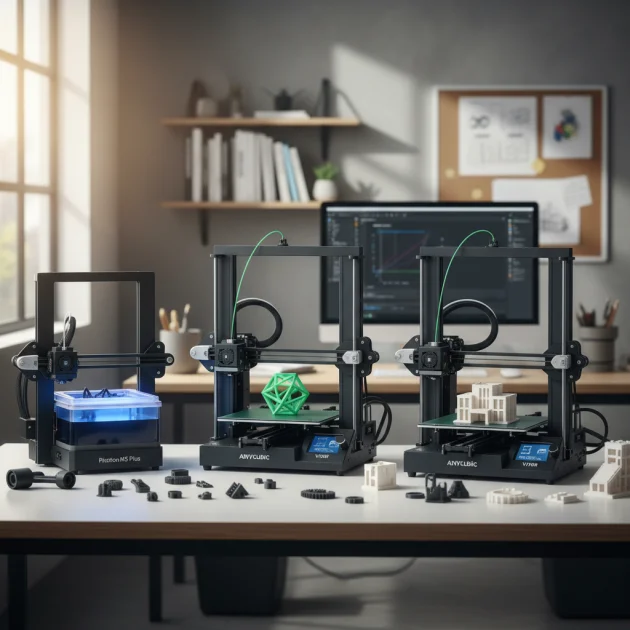
The Anycubic Kobra 2 Pro is the best Anycubic 3D printer for prototyping, offering an exceptional balance of speed, precision, and user-friendliness crucial for rapid iteration. Prototyping demands a printer that can quickly produce accurate models, allowing designers and engineers to test concepts and refine designs efficiently. This guide explores the top Anycubic models, detailing their features and how they meet the specific requirements of prototyping workflows.
Quick comparison
| Model | Build Volume (mm) | Max Print Speed (mm/s) | Key Prototyping Feature | Price Range |
|---|---|---|---|---|
| Anycubic Kobra 2 Pro | 250x220x220 | 500 | High-speed printing, precise details | $$ |
| Anycubic Photon Mono M5s | 218x123x200 | 105 (resin) | Ultra-high resolution for fine details | $$$ |
| Anycubic Kobra 2 Max | 420x420x500 | 500 | Large-scale prototyping, fast | $$$ |
What prototyping needs from a 3D printer
Prototyping requires a 3D printer that prioritizes speed, accuracy, and material versatility. Rapid iteration is fundamental; designers need to quickly produce multiple versions of a part to test form, fit, and function. This necessitates high print speeds without sacrificing dimensional accuracy. A printer capable of maintaining tight tolerances ensures that prototypes accurately reflect the intended design. Material versatility is also critical, as prototypes may need to be printed in various plastics, resins, or even flexible materials to simulate final product properties. Ease of use and reliability minimize downtime, allowing for continuous workflow. Features like automatic bed leveling, quick assembly, and a stable printing platform contribute significantly to an efficient prototyping environment. The ability to handle different filament types, such as PLA, PETG, and ABS, or various resins, expands the range of prototypes that can be created. Ultimately, a prototyping 3D printer must be a dependable tool that accelerates the design cycle from concept to final product.
Detailed reviews
Anycubic Kobra 2 Pro
The Anycubic Kobra 2 Pro stands out for its impressive print speed of up to 500 mm/s, making it ideal for rapid prototyping. This FDM printer features a build volume of 250x220x220 mm, suitable for a wide range of prototype sizes. Its direct drive extruder ensures consistent filament feeding, crucial for reliable prints and minimizing failures during critical design iterations. The Kobra 2 Pro also incorporates automatic leveling, simplifying setup and ensuring a perfect first layer every time. This feature saves valuable time in a prototyping environment where quick starts are essential. Compatibility with various filaments like PLA, PETG, and ABS further enhances its utility, allowing for diverse material testing. The printer’s robust construction contributes to its stability and accuracy, delivering consistent results for iterative design processes. Its user-friendly interface and quick assembly make it accessible for both experienced users and those new to 3D printing for prototyping.
Anycubic Photon Mono M5s
For prototypes demanding exceptional detail and smooth surface finishes, the Anycubic Photon Mono M5s is an excellent choice. This resin 3D printer boasts a 12K resolution screen, enabling it to produce incredibly intricate models with fine features. Its build volume of 218x123x200 mm is generous for many detailed prototypes, especially in fields like jewelry, dental, or small product design. The M5s features a high print speed for a resin printer, reaching up to 105 mm/s, which helps accelerate the prototyping of detailed parts. Its auto-leveling function and intelligent resin detection system streamline the printing process, reducing the learning curve and potential for errors. The precision offered by resin printing is invaluable when evaluating complex geometries or tight tolerances. While resin printing requires more post-processing, the superior surface quality and accuracy often justify the extra steps for high-fidelity prototypes.
Anycubic Kobra 2 Max
When large-scale prototypes are required, the Anycubic Kobra 2 Max delivers with its massive 420x420x500 mm build volume. This FDM printer also achieves a rapid print speed of up to 500 mm/s, allowing for quick production of substantial parts. Its large build plate is perfect for printing full-scale components or multiple smaller prototypes in a single batch, significantly boosting efficiency. The Kobra 2 Max includes automatic bed leveling, simplifying the setup for such a large machine. Its robust frame minimizes vibrations, ensuring accuracy even at high speeds and large sizes. This printer supports a wide array of filaments, providing flexibility for various prototyping needs, from structural components to aesthetic models. The combination of speed and volume makes the Kobra 2 Max a powerful tool for engineers and designers working on larger projects where rapid iteration of big parts is crucial.
Use cases
Anycubic 3D printers excel in various prototyping scenarios. For product designers, the Kobra 2 Pro allows for rapid iteration of consumer product enclosures, ergonomic studies, and functional components. Engineers can utilize the Kobra 2 Max to create large-scale jigs, fixtures, or architectural models, testing fit and assembly before committing to expensive manufacturing. The Photon Mono M5s is invaluable for creating highly detailed prototypes in industries like jewelry, where intricate designs and smooth finishes are paramount for client presentations. Automotive designers can prototype interior components or aerodynamic features. Educators and students benefit from these printers for hands-on learning and project development, quickly bringing theoretical concepts into physical reality. The ability to quickly produce physical models from CAD designs significantly shortens development cycles across diverse industries.
FAQs
What makes an Anycubic printer good for rapid prototyping?
Anycubic printers are well-suited for rapid prototyping due to their balance of speed, accuracy, and affordability. Models like the Kobra 2 Pro offer high print speeds, significantly reducing the time required to produce iterations. Features such as automatic bed leveling and robust construction contribute to consistent, reliable results, which are crucial for quickly testing design changes. Their compatibility with various materials, including common filaments and resins, allows designers to choose the best option for their specific prototype requirements, from functional parts to highly detailed aesthetic models.
Can Anycubic printers handle different prototyping materials?
Yes, Anycubic printers are designed to handle a wide range of prototyping materials. Their FDM printers, such as the Kobra series, are compatible with common filaments like PLA, PETG, ABS, and even some flexible materials. This versatility allows for testing different mechanical properties and aesthetics. Anycubic’s resin printers, like the Photon Mono M5s, support various types of UV-curable resins, including standard, tough, flexible, and castable resins, enabling the creation of highly detailed and specialized prototypes for different applications.
How important is print speed for prototyping?
Print speed is extremely important for prototyping. Rapid iteration is a core principle of effective design and engineering. Faster print speeds mean designers can produce more versions of a prototype in less time, allowing for quicker testing, evaluation, and refinement of designs. This accelerates the entire product development cycle, reducing time-to-market and overall costs. While accuracy should not be sacrificed, a balance between speed and precision is ideal for an efficient prototyping workflow.
Are Anycubic printers easy to set up for prototyping?
Many Anycubic printers are designed with user-friendliness in mind, making them relatively easy to set up for prototyping. Features like modular designs, pre-assembled components, and automatic bed leveling systems significantly reduce the initial setup time and complexity. This allows users to start printing prototypes quickly without extensive calibration. Clear instructions and a supportive community also contribute to a smoother initial experience, which is beneficial for both beginners and experienced users in a fast-paced prototyping environment.
What is the difference between FDM and resin Anycubic printers for prototyping?
FDM (Fused Deposition Modeling) Anycubic printers, like the Kobra series, are generally faster for larger, functional prototypes and offer a wider range of filament materials. They are excellent for testing form, fit, and basic function. Resin (SLA/DLP) Anycubic printers, such as the Photon series, excel at producing highly detailed prototypes with smooth surface finishes and intricate geometries. They are ideal for aesthetic models, small parts requiring high precision, or prototypes where visual fidelity is paramount. The choice depends on the specific requirements of the prototype.
Verdict
For prototyping, the Anycubic Kobra 2 Pro stands out as the top choice, delivering an optimal blend of speed, precision, and ease of use. Its rapid print capabilities and reliable performance significantly accelerate design iterations, a critical factor in any prototyping workflow. While the Photon Mono M5s offers unparalleled detail for intricate models and the Kobra 2 Max provides expansive build volume for large-scale projects, the Kobra 2 Pro offers the most balanced feature set for general prototyping needs. Its versatility with various filaments and user-friendly features make it an indispensable tool for engineers and designers seeking efficiency and accuracy in their development process.
Frequently Asked Questions
What makes Anycubic printers suitable for rapid prototyping?
Anycubic printers are well-suited for rapid prototyping due to their balance of speed, accuracy, and affordability. Models like the Kobra 2 Pro offer high print speeds of up to 500 mm/s, significantly reducing the time required to produce iterations. Features such as automatic bed leveling and robust construction contribute to consistent, reliable results, which are crucial for quickly testing design changes.
Can Anycubic 3D printers use different prototyping materials?
Yes, Anycubic printers are designed to handle a wide range of prototyping materials. Their FDM printers, such as the Kobra series, are compatible with common filaments like PLA, PETG, and ABS. Anycubic's resin printers, like the Photon Mono M5s, support various types of UV-curable resins, including standard, tough, flexible, and castable resins.
How important is print speed when prototyping with a 3D printer?
Print speed is extremely important for prototyping because rapid iteration is a core principle of effective design and engineering. Faster print speeds mean designers can produce more versions of a prototype in less time, allowing for quicker testing, evaluation, and refinement of designs. This accelerates the entire product development cycle, reducing time-to-market and overall costs.
Are Anycubic 3D printers easy to set up for prototyping projects?
Many Anycubic printers are designed with user-friendliness in mind, making them relatively easy to set up for prototyping. Features like modular designs, pre-assembled components, and automatic bed leveling systems significantly reduce the initial setup time and complexity. This allows users to start printing prototypes quickly without extensive calibration.
What is the difference between FDM and resin Anycubic printers for prototyping?
FDM (Fused Deposition Modeling) Anycubic printers, like the Kobra series, are generally faster for larger, functional prototypes and offer a wider range of filament materials. Resin (SLA/DLP) Anycubic printers, such as the Photon series, excel at producing highly detailed prototypes with smooth surface finishes and intricate geometries. The choice depends on the specific requirements of the prototype, whether it's for form/fit testing or high visual fidelity.
Get our weekly buyer guide
Practical specs, not advice. Unsubscribe anytime.
I picked up the Anycubic Photon Mono M5s for some really detailed miniature prototypes. The ultra-high resolution is definitely there, and the prints look incredible. However, the resin printing process is just a bit messier and more involved than I anticipated. It’s great for what it does, but be prepared for the extra cleanup and safety steps.
The Anycubic Kobra 2 Max is a beast! I needed something for larger prototypes, and the 420x420x500mm build volume is perfect. It’s surprisingly fast for its size too, hitting those 500mm/s speeds. My only minor gripe is that it took a bit more tweaking to get dialed in perfectly compared to smaller printers, but once it’s set, it’s amazing.
My old printer just couldn’t keep up with my project deadlines, so I upgraded to the Kobra 2 Pro. The balance of speed and user-friendliness is exactly what I was looking for. It’s been incredibly reliable, and I’m able to test out new concepts much faster now. Worth every penny for serious prototyping.
I’ve been using the Anycubic Kobra 2 Pro for a few weeks now, and it’s a game-changer for my design work. The high-speed printing really cuts down on my iteration time, which is exactly what I needed for rapid prototyping. The precision is also fantastic, even on complex models. Definitely recommend it for anyone serious about quick design cycles.