The Bambu Lab P1S is the best Bambu Lab 3D printer for miniatures, offering an excellent balance of precision, speed, and enclosed printing capabilities crucial for detailed models. Miniatures demand high resolution and consistent performance, which the P1S delivers through its robust design and advanced features. This guide explores various Bambu Lab models, helping you select the ideal printer for your miniature projects, from tabletop gaming figures to intricate display pieces.
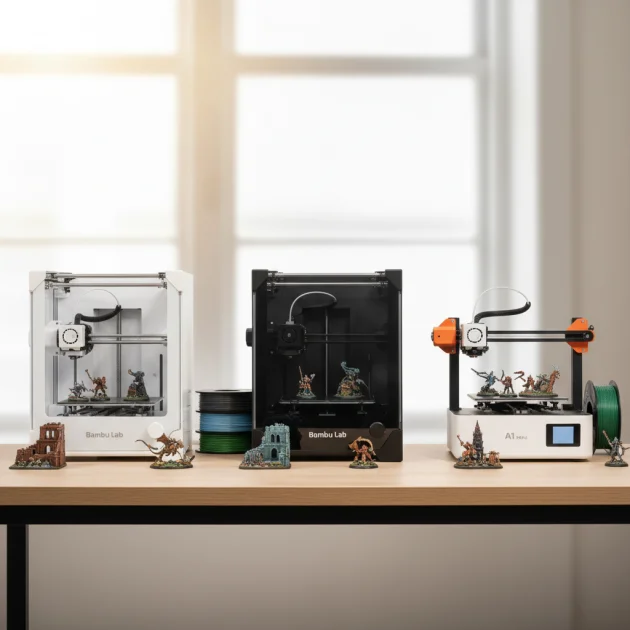
Quick comparison
| Model | Build Volume (mm) | Print Speed (mm/s) | Enclosure | Key Feature for Miniatures |
|---|---|---|---|---|
| Bambu Lab P1S | 256 x 256 x 256 | 500 | Enclosed | Precision and consistent temperature |
| Bambu Lab X1 Carbon | 256 x 256 x 256 | 500 | Enclosed | Lidar for first layer accuracy |
| Bambu Lab A1 Mini | 180 x 180 x 180 | 500 | Open Frame | Compact size, easy to use |
What miniatures need from a 3D printer
Miniatures require a 3D printer that excels in several key areas to produce high-quality, detailed models. First, resolution is paramount. A printer must be capable of fine layer heights (0.08mm or less) and precise nozzle movements to capture intricate details like facial features, weapon engravings, and fabric textures. Second, stability and vibration reduction are crucial. Any wobble or inconsistency during printing can lead to visible layer lines or ghosting, ruining the miniature’s appearance. An enclosed print chamber is highly beneficial, especially for printing with materials like ABS or ASA, which are prone to warping. This enclosure maintains a stable temperature, preventing layer delamination and improving overall print quality. Furthermore, reliable filament feeding and retraction systems are essential to prevent stringing and blobs, which are particularly noticeable on small, delicate models. The ability to use various filament types, including those designed for fine detail, also expands creative possibilities. Finally, user-friendliness and consistent performance ensure a smooth printing experience, minimizing failed prints and wasted material.
Detailed reviews
Bambu Lab P1S
The Bambu Lab P1S stands out as an exceptional choice for miniature enthusiasts. Its fully enclosed design is a significant advantage, providing a stable printing environment that is critical for materials like ABS or ASA, which are often preferred for their durability and detail retention in miniatures. The P1S boasts a rapid print speed of up to 500 mm/s without compromising on print quality, thanks to its robust CoreXY kinematics and vibration compensation. Users can achieve incredibly fine layer heights, essential for capturing the intricate details of miniature figures. The printer’s active carbon filter helps manage odors, a bonus when printing in enclosed spaces. Its large build volume of 256x256x256mm offers ample space for printing multiple miniatures simultaneously or larger, more complex models. The P1S integrates seamlessly with Bambu Studio software, providing an intuitive slicing experience tailored for precision.
Bambu Lab X1 Carbon
For those seeking the absolute pinnacle of precision and advanced features for miniatures, the Bambu Lab X1 Carbon is an unparalleled option. This printer incorporates a Micro Lidar system for micron-level first layer inspection, ensuring perfect adhesion and flawless initial layers—a critical factor for miniature quality. Its hardened steel nozzle and extruder gear allow for printing with abrasive filaments, including carbon fiber reinforced materials, which can add strength and unique finishes to miniatures. The X1 Carbon also features an active chamber heating system, providing even greater temperature control than the P1S, further reducing warping and improving print consistency for challenging materials. Its AI-powered spaghetti detection can save prints by identifying and pausing when errors occur, minimizing material waste. While a higher investment, the X1 Carbon’s advanced sensors and material capabilities make it ideal for professional miniature creators or serious hobbyists demanding the best.
Bambu Lab A1 Mini
The Bambu Lab A1 Mini offers a compact and user-friendly entry point into high-quality miniature printing, especially for those with limited space. Despite its smaller build volume of 180x180x180mm, it still delivers impressive detail and speed, reaching up to 500 mm/s. Its open-frame design makes it easy to access and maintain, though it lacks the environmental control of an enclosed printer. The A1 Mini features automatic flow calibration and active vibration compensation, ensuring consistent print quality even at high speeds. It’s particularly well-suited for PLA and PETG miniatures, which are less prone to warping than ABS. The printer’s intuitive interface and quick-swap nozzle system make it an excellent choice for beginners or those who prioritize ease of use. While not as robust for exotic filaments as its enclosed counterparts, the A1 Mini provides excellent value and performance for standard miniature printing.
Use cases
The best Bambu Lab 3D printers for miniatures excel in various use cases. Tabletop gamers will find these printers indispensable for creating highly detailed character models, terrain pieces, and custom game tokens. The precision allows for accurate representation of intricate designs from popular game systems. Hobbyists can produce display-quality figures, busts, and dioramas with fine textures and sharp edges. Artists and sculptors can rapidly prototype and iterate on their designs, bringing digital models to life with exceptional fidelity. Even product designers can utilize these printers for creating small, functional prototypes or intricate components where dimensional accuracy is paramount. The ability to print with various materials, from standard PLA to more durable ABS or even specialized resins (with appropriate modifications), expands the range of applications for miniature creation.
FAQs
What layer height is best for printing miniatures?
For printing miniatures, a layer height of 0.08mm or even 0.04mm is generally recommended. Finer layer heights significantly reduce visible layer lines, resulting in smoother surfaces and sharper details. While printing at lower layer heights increases print time, the improved aesthetic quality is crucial for miniatures where fine details are paramount. Experimenting with different layer heights for specific models can help achieve the optimal balance between detail and print duration.
Can Bambu Lab printers use resin for miniatures?
No, Bambu Lab printers are FDM (Fused Deposition Modeling) printers, meaning they use filament (plastic spools) to build objects layer by layer. Resin 3D printers (SLA/DLP/LCD) use liquid resin cured by UV light, which is a different technology. While FDM printers like Bambu Lab models can produce excellent miniatures, resin printers typically offer even finer detail and smoother surfaces for very small, intricate models. You cannot use resin directly in a Bambu Lab FDM printer.
Is an enclosed printer necessary for miniature printing?
An enclosed printer is highly beneficial for miniature printing, especially when using filaments like ABS, ASA, or certain high-temperature materials. The enclosure helps maintain a stable internal temperature, preventing warping, cracking, and layer delamination that can occur with these materials. For PLA, an enclosure is less critical but can still offer benefits by protecting the print from drafts and dust. For optimal results and material versatility, an enclosed printer is a strong advantage.
How important is print speed for miniatures?
While print speed is a notable feature of Bambu Lab printers, precision and detail are more critical for miniatures. High speeds are beneficial for reducing overall print time, but they should not come at the expense of quality. Bambu Lab printers are designed to maintain high quality even at fast speeds due to their robust kinematics and vibration compensation. However, for the most intricate miniatures, slightly reducing speed can sometimes yield even finer details and fewer artifacts.
What filament types are best for miniature printing?
PLA is a popular choice for miniatures due to its ease of printing, wide color range, and good detail retention. ABS and ASA offer greater durability and heat resistance, making them suitable for gaming pieces or models that require more robustness, but they benefit greatly from an enclosed printer. PETG is another good option, balancing ease of use with improved strength over PLA. Experimenting with specialty filaments designed for fine detail can also yield excellent results.
Verdict
For miniature enthusiasts, the Bambu Lab P1S emerges as the top recommendation. Its enclosed design, high precision, and rapid printing capabilities provide an ideal environment for producing highly detailed and consistent miniatures. While the X1 Carbon offers advanced features like Lidar and active chamber heating for the most demanding users, the P1S delivers exceptional value and performance for the majority of miniature printing needs. The A1 Mini serves as an excellent compact and user-friendly option for those prioritizing ease of use and standard filament printing. Ultimately, any of these Bambu Lab printers will significantly improve your miniature creation experience.
Frequently Asked Questions
What layer height is best for printing highly detailed miniatures?
For printing miniatures, a layer height of 0.08mm or even 0.04mm is generally recommended. Finer layer heights significantly reduce visible layer lines, resulting in smoother surfaces and sharper details. While printing at lower layer heights increases print time, the improved aesthetic quality is crucial for miniatures where fine details are paramount.
Can Bambu Lab FDM printers use liquid resin for miniature creation?
No, Bambu Lab printers are FDM (Fused Deposition Modeling) printers, meaning they use filament (plastic spools) to build objects layer by layer. Resin 3D printers (SLA/DLP/LCD) use liquid resin cured by UV light, which is a different technology. You cannot use resin directly in a Bambu Lab FDM printer.
Is an enclosed 3D printer chamber necessary for printing miniatures?
An enclosed printer is highly beneficial for miniature printing, especially when using filaments like ABS, ASA, or certain high-temperature materials. The enclosure helps maintain a stable internal temperature, preventing warping, cracking, and layer delamination. For optimal results and material versatility, an enclosed printer is a strong advantage.
How important is print speed when producing intricate miniatures?
While print speed is a notable feature of Bambu Lab printers, precision and detail are more critical for miniatures. High speeds are beneficial for reducing overall print time, but they should not come at the expense of quality. Bambu Lab printers are designed to maintain high quality even at fast speeds, but for the most intricate miniatures, slightly reducing speed can sometimes yield even finer details.
What are the best filament types to use for 3D printing miniatures?
PLA is a popular choice for miniatures due to its ease of printing, wide color range, and good detail retention. ABS and ASA offer greater durability and heat resistance, making them suitable for gaming pieces or models that require more robustness, but they benefit greatly from an enclosed printer. PETG is another good option, balancing ease of use with improved strength over PLA.
Get our weekly buyer guide
Practical specs, not advice. Unsubscribe anytime.
The Bambu Lab X1 Carbon is fantastic for miniatures, especially with that Lidar feature. My first layers are always perfect, which is crucial for tiny parts. It’s a bit of an investment, but the quality for intricate display pieces is definitely there.
I picked up the Bambu Lab A1 Mini for its compact size, and it’s mostly good for my smaller projects. However, being an open frame printer, I’ve noticed some slight temperature inconsistencies on really long prints, which can affect very fine details. It’s easy to use, though.
I’ve been using the Bambu Lab P1S for my D&D figures, and it’s been a game-changer. The precision is incredible, and I’ve had zero issues with warping thanks to the enclosed printing. It really does deliver on those detailed models, making painting so much easier.
My P1S has been a workhorse for tabletop gaming figures. The speed is impressive without sacrificing any of the detail. I used to spend so much time post-processing, but with this printer, the prints come out almost perfect every time. Highly recommend for anyone serious about miniatures.